Sunday, 5 January 2014

Miami Key Biscayne Running Route

Click here for route map
Length 5.3 km (3.3 miles), terrain: flat (like all of South Florida)

Most pictures courtesy of the creative folks at Flickr Creative Commons. Thanks!

Miami Running Routes:
South Beach
Coconut Grove

Key Biscayne
For more running routes, see Route List.

Here's a little corner of the real, original Florida, hidden away. And surprisingly, it's right inside Miami: Bill Baggs Cape Florida State Park, on Key Biscayne. You can get to this island by driving over the Rickenbacker Causeway from the south end of Miami. You have to pay a few dollars to get into the park, but you'll be glad you did.

Key Biscayne is the southernmost island lining the north end of Biscayne Bay, just north of the natural entrance into the bay.
View from the lighthouse south to Cape Florida, photo by Tach_RedGold&Green
The island is split into three parts: the northernmost section (just after the bridge) is occupied by Crandon Park, with a great beach and nature center along the eastern shore, facing the Atlantic. When I was a kid, growing up just north of Miami, Crandon Park also housed the zoo, south of the parking lots. The western side of Crandon Park is occupied by a golf course, a gigantic tennis center and a lot of inaccessible mangrove thickets.

Then, in the middle part of the island, comes Key Biscayne Village, with beautiful homes on the west side of the main road, and stupid high-rises lining the east side.

And then -- on the southern third of the island, with Cape Florida -- comes the best part. It has been preserved as Bill Baggs Cape Florida State Park. It has the nicest beach around (voted as one of the 10 best in the US), a lighthouse, a little harbor, loads of trails and great views in every direction. As a state park, you just have to make sure that you go there during opening hours: from 8 a.m. till sunset every day.

And, hey, once you've made the effort to go there and you've paid your money, you might as well plan to make a day of it: bring your swimming gear, maybe some picnic food or even a fishing pole. The beach is more natural -- and normally much less crowded -- than Miami Beach. This is the place to kick off your running shoes later and enjoy paradise for a bit longer!

After you pay at the park entrance station, drive past the first picnic area to go south to the main swimming area, with the snack bar, near the lighthouse. Now walk out over the boardwalk to the beach and look around before you start running. The Cape Florida lighthouse is directly south of you, along the beach. The lighthouse was built in 1825 to guide sailors into Biscayne Bay.
The Bill Baggs beach and lighthouse, photo by Keith Hauser
We want to run past the lighthouse, running clockwise along the shore, following the southern tip of the island (Cape Florida), then back up the west shore to No-Name Harbor, see a few mangroves, then cut across the island back through the picnic area to the beach, then head back south to the starting point, right here at this wonderful beach.
The lighthouse, photo by Ron Wiecki
Unfortunately, the beach is blocked by a fence directly in front of the lighthouse. The lighthouse and the lighthouse-keeper's house and a 100-meter section of beach are all fenced-off. So we'll first have to take the last path through the dunes on the right, back to the parking lot, then take the trail leading past the lighthouse to the south. You might want to run to the lighthouse first, just to see it from close-up, then back to take the path that takes you back to the beach, south of the fenced-off area.

From now on, there are no more obstacles. Just run along the water's edge, with the Atlantic waves rolling over the sand, and the seagulls and pelicans winging overhead.

You'll round the tip of Cape Florida, and start heading north, going by the end of the parking area. On the bay side of the island, there is no beach, and the rocky shore is used by fishermen and nature lovers, with occasional docks for fishing and bird-watching scattered along the shore. The trail is lined by Florida's state tree: the sable palm. You can see westwards across Biscayne Bay, and the sunsets here can be beautiful.
Sunset along the trail on the west side of the island, photo by dania102100
At the 2-km mark, you come to No-Name Harbor, a little anchorage with a restaurant, the Boater's Grill. Follow the path as it curves around the little bay.

When you pass the restaurant and parking lot, keep running along the water, until -- about halfway around the north side of the harbor -- you come to the trail that leads off through the mangroves north of here. Turn right onto the mangrove trail and follow it to the end, where there is a lookout over the lagoon, and then head back to the harbor again.
Pelican on a seawall, photo by onebrowncookie
Most of the Florida bays were once lined with such mangroves, and this area is also being restored. The whole area north of No-Name Harbor had been buried under sand dredged up from the bottom of Biscayne Bay to build more houses, but Miami Herald editor Bill Baggs started a campaign to save this corner of Key Biscayne, and the State of Florida bought the land. Since then, Florida naturalists have been restoring the land to a half-way natural state.

When you get back to the harbor again, run back to the parking lot near the restaurant and now follow the bicycle path eastwards, cutting across the island.

When you get to the main road, cross the road into the picnic area parking lot and follow the boardwalk out to the beach. The beach is narrow here, and not many people swim at this spot.
Crossing the dunes to the beach, photo by Keith Hauser
Now turn right to head south along the sand to the starting point. It's easiest to run on the wetter, hard-packed sand right at the water's edge. I like to take off my shoes when doing a beach run: there's nothing like the feel of sand between your toes to make you feel like you've just landed in paradise.

You'll see the lighthouse down the beach as you approach. And when you get back to the start, you can jump into the water to cool off with a good swim, take a freshwater shower and enjoy some more of that good old Florida beach life.

Friday, 3 January 2014

Most Popular Runs: Top 10 Routes

What were the most popular running routes of the last year, worldwide? You readers chose the most interesting routes yourselves, using your own computer mice and touchscreens. Here are the 10 most-viewed routes of the past twelve months:
Runner's feet relaxing in the hotel pool after a run down the Strip: no wonder this is popular!
  1. Las Vegas Strip
  2. Washington DC Mall
  3. Paris Seine Loop
  4. London Hyde Park
  5. Sydney Central Business District
  6. Hong Kong's Bowen Road
  7. New York Midtown/Central Park
  8. Rome's Villa Borghese Garden
  9. Miami Beach's South Beach
  10. Istanbul Sultanahmet Old Town
The next five places were occupied by routes in Singapore East Coast Park, Berlin Tiergarten, Istanbul Bosporus, Washington DC Georgetown, and San Francisco Downtown.

We'll see if they can hold up against the new routes coming up... The next routes for Miami, New York, Birmingham (UK) and Lisbon are already waiting to guide more traveling runners onto some of the world's great trails!

Sunday, 29 December 2013

Prague Old-Town/New-Town Running Route

Click here for route map
Length 6.8 km (4.2 miles), terrain: flat

Pictures courtesy of the creative folks at Flickr Creative Commons. Thanks!

Prague Running Routes:
Old-Town / New-Town Run
Petrin Hill Run
For more running routes, see Route List.

Prague, Europe's most beautiful medieval city (in my opinion, anyway) awaits with all kinds of interesting neighborhoods and sights. This one combines parts of the old town and the new town (the area surrounding the old medieval core), with a long, scenic stretch along the Vltava River.

Of course, the most fascinating sights are in the old town areas on both sides of the river. But since the end of the Cold War brought a flood of western tourists, there is little left in the old town of real Czech culture, where local people themselves go to shop and eat. Everything has been transformed into souvenir shops, hotels and tourist restaurants. So that's why I've included some of the new town in this route: to experience a few neighborhoods full of local people and normal Czech life.
Wenceslas Square, photo by Clyde Bentley
We'll begin the run in one of the most important historic sites in town: on Wenceslas Square, in front of the imposing National Museum. This site, at the statue of King Wenceslas, is where the Prague Spring rebellion against Soviet rule began in 1968.

Wenceslas Square is more a wide boulevard than a square. It itself is in the new town, with buildings from the Victorian age to art-deco to more modern ones lining the street. Turn your back on the statue and run downhill (northwest) through the narrow park for three blocks until you come to where the tram tracks cross, at Vodičkova, where you turn left.

This street isn't especially scenic, with lots of offices, restaurants and shops along the way, but you're already away from the tourists. When the tram tracks turn to follow the street to the right, keep going straight on Vodičkova towards the ancient gothic tower, a block ahead.
Charles Square, photo by Martin Laver
The tower is from the town hall of the new town, at Charles Square. The square forms the center of the new town, and it used to be an ancient market square, beginning as a slave market outside the city. Now it's just a nice park for the local people who live in the many apartment houses in the neighborhood.

Run south through the square, which is bisected by two cross-streets, to the southern end. Turn right here to run westwards along Na Moráni. In four short blocks you'll come to the Vltava River.

We'll now cross the river over the Palackého Most (bridge). The riverside is quieter on the other side.
Dam along the Vltava, photo by Ben Jeffrey
When you cross the bridge, take the steps down to the riverside street below, Nábřežní, and begin running north. You can run right down at the water's edge here, until the cobblestoned parking lot joins up with Nábřežní again.

Run under the next bridge and then, just past the white tower at the water, there's an interesting spot to get out into the river and experience it from much closer. Take the path that goes over the arched bridge to Detsky Island. You can view the water cascading over the dam across the river, which diverted much of the water to watermills along each shore.
Vltava swans, photo by Peter Mulligan
Now head north again along the river road, running under the next bridge, Most Legií.

Just 100 meters after the bridge, you'll come into a riverside park, on Kampa island. You'll have to run around the Kampa Museum (ex watermill) and you'll exit the park onto Na Kampě, a pleasant little tree-lined square between old houses.

NOTE: This part of the run overlaps with the other Prague route, the Petrin Hill Run.
Na Kampě square, photo by Cedricounet
In just 100 meters, you'll come to the ancient Charles Bridge, which crosses the street above you. Just run straight through the archway under the bridge and continue until the street ends at the house right in front of you. The castle and numerous smaller palaces crown the hill going up to the left.

Now turn right onto U Lužického Semináře, and follow it to a little triangular square just 200 meters ahead. You'll see a cobblestoned street going down to the water to the right, with a little park next to it. Turn right into the park and then follow the path up to the next bridge, Mánesův Most.

Now cross over to the east side of town again.

Just as you reach the far end of the bridge, at Jan Palach Square, turn left to run along the water past the beautiful Czech Philharmonic Orchestra building and then past next big building.

Now turn right onto Břehová to run past the back end of the Jewish cemetery, in the old ghetto. The cemetery is raised much higher than the rest of the surrounding streets, because the restricted space forced people to bury the dead above each other.
New-Old Synagogue and Jewish Town Hall, photo by cojs images
After two blocks you come to a little green square, where you turn right onto Maiselova, where you run past the gothic-style Old-New Synagogue, and then the Renaissance-style Jewish Quarter town hall. Look for the clock with the Hebrew numbers: it turns backwards!

Most of the rest of the old ghetto was torn down 100 years ago in an urban-renewal project, and replaced with houses of that era.

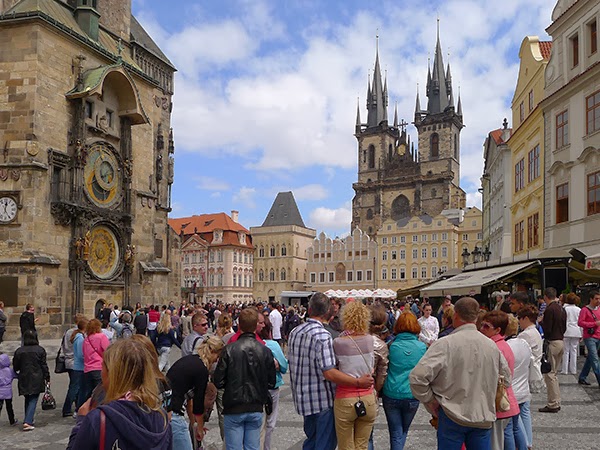
Following Maiselova southwards, you'll pass another old synagogue and then come to a big baroque church, St. Nicholas, on the left side, with a small passageway leading to the Old Town Square. You'll see the fascinating gothic towers of the Tyn Church across the square.
The main square and the Tyn Church, photo by Reuben Bluff
Take a loop around this square, forming the heart of the old town, going around the Jan Hus fountain, and past the Tyn Church. The Tyn Church marks the beginning of the Tyn neighborhood behind it. The Tyn quarter was a fenced-in area where foreign merchants (mainly Germans) could set up their warehouses and stalls and sell imported goods.

Now circle around the gothic town hall, past its amazing astronomical clock, a work of unrivaled medieval workmanship.
Astronomical clock at the town hall, photo by Sarah S.
Turn your back to the clock, and now take the narrow lane, Melantrichova, heading southeast back towards Wenceslas Square. You'll pass the Haveleska market stands and then exit onto the northwest end of Wenceslas Square.

Now just run straight down the street, back to the statue of King Wenceslas.